


Welcome
Dear Friends of the National Center for Healthy Veterans at Valor Farm,
This month of June is characterized by a number of military significant days. Certainly “The Longest Day” (Normandy, June 6, 1944) is a landmark of service and sacrifice by American and Allied Militaries to begin unhinging the entire European continent from an evil empire. For a moving commemoration of D-Day, see “The Longest Day” in the Media section.
Another significant military commemoration day is June 14, 1775, which recognizes formation of the Army and June 14, 1776, when the initial American Flag design was determined, both directed by the Continental Congress. June 14 (Army Birthday and Flag Day) is a day to honor the service and sacrifice of our Army, as well as the intangible motivation of our beloved Stars and Stripes which has flown over every battlefield in our nation’s history.
One more day of note in June is June 25, 1950, the day that North Korea conducted a surprise attack of South Korea, pushing rapidly to the very southern tip of the peninsula and trapping US and South Korean militaries in the Pusan perimeter. Yet again, the determination and resilience of American and Allied militaries eventually regained the lost territory and fought to a stalemate at the end of three years, a conflict which has never terminated with a treaty. The Korean peninsula remains volatile in what former President Bill Clinton called “the most dangerous place on earth.”
Clearly, Freedom is Never Free. Our Veterans and our Military of today, along with their families, have paid this price. May we continue to honor their service and sacrifice on our behalf.
Here are some impacts from the National Center for Healthy Veterans this month:
Plays of the Day – Dallas Event, Shelton House Dedication, Huber House Dedication, Village 2 Construction, New Arena Construction
Meet the Team – Jason Burger, Groundskeeper
Diving Deeper – Make America’s Veterans Healthy Again (MAVHA)
In The Media – The Longest Day video, Hope for the Heart Podcast, NCHV Veterans Recruitment brochure
Prayer Points – Join us in prayer as we continue to support and empower Veterans.
Thanks again for your encouragement, your volunteerism, your gifts-in-kind, your financial donations, your referrals of Veterans in need, and your prayers.
Blessings and gratitude to each of you,

Robert F. Dees
Major General, U.S. Army, Retired
President and CEO, National Center for Healthy Veterans

YOUR encouragement and generosity
have made these amazing things happen at Valor Farm. We certainly welcome and need your further support on behalf of Returning Healthy Veterans to America!


Join our Healthy Veterans Community!
Plays of the Day


Dallas Event – We were thrilled to host a powerful “friend-raiser” at the Hope Center in Dallas, where meaningful connections were made and stories of impact were shared. Our guest speaker, Chad Hennings, brought a compelling message of purpose and service. One unforgettable highlight was the D-Day flag brought by Mercury One—an inspiring and timely symbol just days after the anniversary.


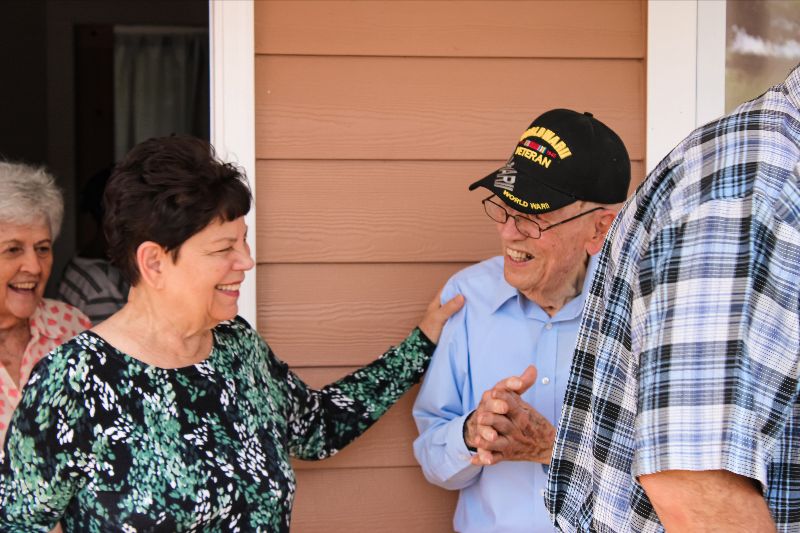
Shelton House Dedication – We were honored to dedicate a new home in Village 1 to Gordon Shelton, a WWII Okinawa veteran. The event celebrated Gordon’s legacy with stories from those who know him best, showing the quiet strength and character that define him.


Huber House Dedication – We were proud to welcome the Huber Corporation for the dedication of their sponsored home in Village 2. Corporate partnerships like this make our mission possible, and we’re deeply grateful for their commitment to our Veterans.


Village 2 Construction – Village 2 is coming to life! All 12 exteriors are complete, interior work is underway, and the community center’s foundation has been poured. With the help of our Patriots and staff, we even raised the community center walls—momentum is building!


New Arena Construction – Our new arena is rising from the ashes. Footers are poured, steel has arrived, and construction is underway as we prepare to launch our Fire Relief Campaign. We’re deeply thankful for the continued support that’s making this rebuild possible.
Meet The Team


Jason Burger – Grounds Supervisor
Hi, my name is Jason Burger. I was born in Lynchburg, Virginia, but spent most of my childhood in Florida. In 2020, I married a wonderful, God-honoring woman named Nikki. We have five amazing children—four girls and one boy—ranging in age from 3 to 14.
I moved back to Lynchburg in 2000 to attend Liberty University, where I earned a degree in Interdisciplinary Studies (which is perfect for people who aren’t quite sure what they want to do when they grow up—ha!). My focus areas were Sport Management and Religion.
Today, I’m blessed to serve as Grounds Supervisor at Valor Farm. I’ve worked in landscaping for over 25 years, and I truly enjoy it. It’s been a gift beyond words to work shoulder to shoulder with our nation’s patriots. I often find peace in the work itself and great encouragement in seeing how God blesses the farm and moves in the hearts of those who come here.
I actually discovered the National Center for Healthy Veterans by accident. After moving to Altavista a few years ago, I noticed the Healthy Veterans Market from the highway and decided to stop in and check it out. I had a great conversation with a friendly volunteer named Keith, who gave me a brochure for NCHV and invited me to attend the Thursday night campfires.
When I looked at the brochure, I was surprised to recognize a familiar face—retired Major General Bob Dees. As an Army veteran myself (eight years of service), I had the opportunity to attend a conference led by General Dees at Liberty University back in 2012. That event helped me recognize and begin to properly address the challenges of post-traumatic stress from my deployment to Iraq in 2006–2007.
It was at that conference that I found real hope for my future—and peace and strength through Christ. So now, being part of NCHV feels humbling and deeply meaningful. It’s a blessing to be in a place where we share the hope that only Jesus can give.
Diving Deeper

Making America’s Veterans Healthy Again (MAVHA)
By Major General Bob Dees, U.S. Army, Retired
Defining Veteran Health
Many of our Nation’s Veterans navigate trauma and woundedness of military service and never look back, moving into lives of purpose and continuing service to God, nation, and others. They may need a tune up or a hand up now and then, but they are essentially healthy. The reality, however, is that many more of our nation’s Veterans continue to look through the rear-view lens of their trauma, stuck in pain and aimlessness, with their families caught in the collateral crossfire. These Veterans are not Healthy – but they can be.
There are five key vectors of wellness that define HEALTHY: Physical, Mental, Spiritual, Emotional, and Relational (PMSER). For brevity, let’s call this PMSER wellness, categorized in clusters below:
- PHYSICAL: Sleep Hygiene, Nutritional diet of natural food sources, Fitness (Aerobic, Strength, Flexibility), Hygiene (including dental flossing), beneficial use of supplements, awareness of “your numbers” (blood pressure, cholesterol, et al), elimination of environmental toxins
- MENTAL: Mental engagement and stimulation, Memory, Brain Health, Clarity and Communication, Screen regulation, Positive and Balanced Dopamine production
- SPIRITUAL: Ethical development, mindfulness, prayer, faith practices related to a specific set of beliefs or value system, identity, purpose, relationship with a higher power, study and meditation on sacred texts
- EMOTIONAL: Emotional Regulation, Anger Management, Constructive Speech, Self-esteem, Gratitude
- RELATIONAL: Friends, Authentic and Accountable Relationships, Conflict Resolution, Forgiveness, Trust, Family and Parenting principles
It must be noted that PMSER categories are frequently intertwined. For example, a good night’s sleep allows neurotransmitters to replenish and restore brain function (mental), reduces anxiety producing emotions (emotional), and allows the body time to heal (physical). In essence, we are complex integrated human organisms who are “fearfully and wonderfully made.” (Psalm 139:14)
Primary PMSER Presenting Needs:
The recently issued MAHA assessment of Children’s Chronic Disease listed four main causal factors: 1) Poor Diet exacerbated by Ultra-processed Foods, 2) Environmental exposure to chemical toxins, 3) Lack of Physical Activity, and 4) Over-medicalization, especially over medication. Each of these applies to the Veteran population as well as military related injuries including a spectrum of post-traumatic stress disorder (PTSD), mild traumatic brain injury (mTBI), moral injury (MI), adverse childhood experiences (ACE) precipitated by challenging military service, and other physical trauma. As well, Alcohol Use Disorder (AUD) and Substance Use Disorder (SUD) are co-morbid with many of these other conditions. Finally, a high occurrence of diagnosed and undiagnosed personality disorders (PDs) further complicates Veteran therapy and healthcare. These presenting needs and overall PMSER wellness must be addressed nationwide in order for Amercia’s Veterans to truly be healthy and able to continue to give back to America and others.
THE NEED FOR DISTRIBUTED AND COMPLIMENTARY VETERAN CARE
There are thousands of private sector Veteran outreach organizations who are doing noble work individually, as well as public sector entities starting with the Department of Veterans Affairs (DVA), Department of Health and Human Services, and similarly focused State and Local entities. At present, however, there is not sufficient public-private collaboration or a useful nesting of private sector organizations to provide comprehensive continuity of care. This presents several challenges:
The current DVA statistic reflects that roughly 30% of America’s Veterans are properly connected to the VA system. The other 70% are in the “woodwork of America.” Hence the first task is finding the Veterans who need comprehensive care, recognizing that those truly at-risk to suicide and other mental, behavioral, social challenges generally do not want to be found. A far more active search and referral mechanism to find Veterans in need is required. We must find them, then refer them to the right public or private organization that can meet their specific needs. This is hard. We must do better.
While the identification of promising therapeutic technologies continues to accelerate, there are no silver bullets. Therapy or technology that may be highly effective for one Veteran often falls flat with others. A holistic approach which offers a combination of therapeutic approaches is generally more effective in treating a broad range of Veteran issues. Upfront diagnostic assessments of Veterans and pairing of most beneficial therapeutic approaches for that particular Veteran is essential. As well, empiricals and process to assess the constant stream of emerging technologies are needed to separate the wheat from chaff.
Widespread knowledge of and partnership with varying organizational capabilities is also required. As an example, there are a number of private organizations who provide permanent housing for Veterans. This is certainly a necessary provision, but a roof does not solve life issues which the Veteran and his family drag with them. In addition to housing, food security, and basic health needs; the real question is how do we help at-risk Veterans and families “rewire the brain, reshape the heart, restore the soul?” This requires a comprehensive integration of proven best practices to effect true life change, growth, and an altered future for these Veterans.
Also on the subject of permanent housing for Veterans, the current administration recently announced plans to place 6,000 formerly homeless veterans into a VA facility in Los Angeles County. This is a noble objective, but the desirability and feasibility of concentrating this large number of Veterans with significant life issues and probable AUD/SUD complications into a single housing area is a questionable approach.
Alternatively, the thesis of this white paper is that a distributed public-private network of complementary organizations networked nationally and regionally is sorely needed. Critical to this network is a series of regional “healing platforms” (referred to as Healthy Veteran Centers, such as the National Center for Healthy Veterans prototype described below) that provide transition (nine-month) residential care and healing for Veterans (including formerly homeless, incarcerated, traumatized) on a State-by-State basis.
A NATIONAL PROTOTYPE FOR COMPREHENSIVE VETERAN CARE
This think piece seeks to address a critical gap in Veteran Care — specifically the need for longer term residential programs with a holistic integration of proven best practices that help at-risk Veterans achieve a true life reset which can only occur over months instead of days or weeks. In essence, a “crockpot in a microwave society.” Such a longer-term residential, holistic program for at-risk Veterans is an important means to “Make America’s Veterans Healthy Again” (MAVHA).
The Key Elements of the recommended National Prototype (referred to as Healthy Veteran Centers) are as follows:
Community (in tiny home villages) to defeat isolation, a primary cause of Veteran suicide.
Dignified Work to regain purpose and self-esteem.
Faith-based trauma recovery and life skills programs, integrating national best practice core programs along with mini-courses for financial literacy, sleep hygiene, family relationships, and others.
Career Preparation in trades or other professions to ensure professional success.
Natural healing platform to leverage the therapeutic power of God’s creation.
Comprehensive Therapy including conventional clinical therapy (licensed professional counseling), thorough PMSER assessments, equine assisted therapy, horsemanship, art and crafts therapy, and Agri therapy (nutritious food cultivation, plants, bees).
Referral Partners (public and private) who identify Veterans in need of participation in a longer-term Healthy Veteran Center.
Peer Mentors who coach Veterans toward growth and achievement of PMSER objectives.
Business model that promotes sustainability of a healthy food supply and revenue for ongoing operations.
CONCLUSION
A distributed public-private network of complementary organizations networked nationally and regionally is sorely needed to comprehensively address the significant health issues faced by America’s Veterans. Critical to this network is a series of regional “healing platforms” (referred to as Healthy Veteran Centers, such as the National Center for Healthy Veterans prototype) that provide transition (nine-month) residential care and healing for Veterans (including formerly homeless, incarcerated, traumatized) on a State-by-State basis.
Next Steps to Make America’s Veterans Healthy Again include:
Initiate a “Making America’s Veterans Healthy Again (MAVHA) Assessment” (similar to the initial HHS children’s health initiative) to better categorize the health and wellness challenges America’s Veterans face.
Promote further development of regional Healthy Veterans Centers such as described in this white paper.
HHS and VA establish a joint-working group to achieve an integrated solution to Veteran health and wellness, forming a public-private echelon of care that addresses the many different types and severities of challenges our nation’s Veterans face.
This integrated solution must include a “Search and Rescue” referral system for the Veterans in greatest need who generally don’t want to be found and who are most at-risk to suicide or societal disruption. While it is good to help reasonably healthy veterans get better (as many organizations do), it is essential that we develop a new capability to identify, refer, and truly help those who are still trapped in the iceberg of trauma and despair.
Final Note:
The Vision for the National Center for Healthy Veterans (NCHV) is to “Reshape the Nature of Veteran Care in America.” In addition to establishing a national prototype to “Return Healthy Veterans to America,” NCHV is also well suited to be a nation thought leader for Veteran Care. The observations and recommendations above are integral to this Vision and foundational to a MAHA movement on behalf of our nation’s Veterans (MAVHA).

“The Longest Day” by West Point Glee Club
Hope For The Heart podcast, Building Resilience & Caring for Our Veterans with Maj. Gen. Bob Dees (Ret.)

Calendar


- Thursdays at 4:00 p.m. Scheduled Tours
contact@healthyveterans.org if interested. - First & Third Thursdays: Community Campfire at Valor Farm 6pm Come join us for fellowship!
- True Grit Rodeo: June 20-21
- NCHV at Philadelphia Fundraiser – June 26th
- Timberlake House Dedication: June 29
Hillcats Military Appreciation Game: August 2
Link to buy Discounted Tickets: https://www.gofevo.com/event/Nationalcenter7
Prayer Points


- Pray for transition of leadership in Washington D.C., and for national security at home and abroad.
- We give thanks for the visible and invisible signs of healing and restoration in the lives of our Veterans. May these transformations continue to blossom, a testament to Your love and the dedication of those who serve them. Amen.
- Without mentioning specifics, pray for the many Veterans and their families in our midst who have financial issues, health crises, relational dysfunction, and suffer from mental and emotional challenges. May God bring wellness to Veterans throughout the land. May we together, “Return Healthy Veterans to America”
- Join us in praising God for the beauty of His Creation — horses, rivers, cattle, valleys, chickens, the fruit of the land, the beauty of the fields, the wonder of His Creation.
- Pray that the work of the National Center for Healthy Veterans would rapidly advance to provide help, hope, and healing for our nation’s Veterans and their families.


